The short version
- Do not reorganise, laminate, tape, clean, annotate or post original material before its existing order and condition are recorded.
- Begin with a collection-level description and phone photographs; a finished scan or written family history is not required for an initial contribution.
- The evidence pack should record item number, description, creator, approximate date, people, place, working/company, how it came through the family, rights, privacy limits and unresolved questions.
- Separate what the object shows, what another source confirms, what the family remembers and what remains speculation.
- Ownership, publication permission, credit or anonymity and withdrawal before publication are agreed in writing; original custody stays with the family unless a qualified archive separately accepts it.
The story is valuable; the context makes it evidence
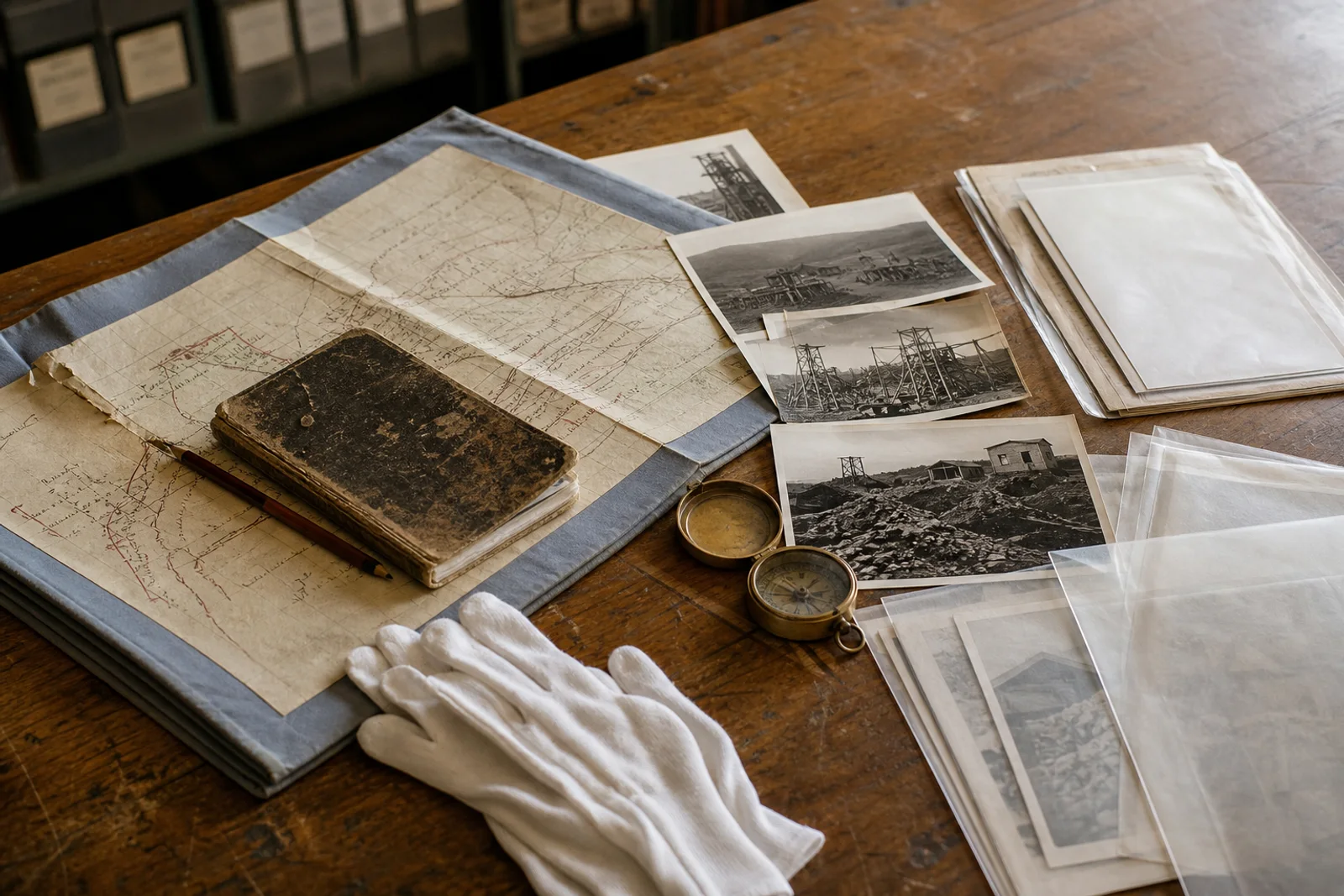
A photograph of three people beside a poppet head may be visually powerful, but it becomes searchable evidence only when the contributor records who held it, where it came from, what is written on the front and back, which names are remembered, what place is suspected and which parts are uncertain. A pay book becomes more useful when its dates, employer names, abbreviations and custody are preserved. An annotated map needs both sides, folds, envelope and related notes.
The goal is not to make a family prove every detail before speaking. It is to prevent the editorial process from hardening recollection into fact. The evidence pack keeps four layers separate: the object itself; its provenance or custody; external corroboration; and family interpretation. A short contribution can then support a correction, a caption, a source note or a longer article at the right evidence level.
State Library Victoria’s goldmining guide points to diaries, personal papers, photographs, memoirs, newspapers, maps and official material across different collections. Its family-history tools connect directories, newspapers, maps and research guidance. The family box often supplies the bridge between those institutional records—a nickname, address, contractor name or hand-drawn location that makes the formal search possible.[3][2]
The first hour: preserve order and record condition
Keep the collection together. Photograph the box, folder, album or bundle before removing items, then photograph the sequence as found. Do not sort by what looks most interesting. Existing order can show that a map belonged with a diary, that photographs came from one branch of the family or that a newspaper clipping was deliberately kept beside a letter.
Use clean, dry hands and a clear surface. Do not laminate, use adhesive tape, erase notes, flatten brittle folds, clean photographs with household products or force a binding open. National Archives of Australia preservation guidance emphasises appropriate storage and handling because heat, humidity, light, pests and unsuitable enclosures can accelerate damage. If material is mouldy, wet, actively flaking or stuck together, stop and seek qualified advice.[1]
Write a collection-level note: who currently holds it, whose papers they are believed to be, where it was stored, when it was last reorganised and whether anyone added labels. This note can be one paragraph. It is more valuable than an elegant chronology written after items have been separated from their original relationships.
Build a simple inventory before a narrative
Assign temporary identifiers such as BOX1-F01-I001. Describe what is visible without interpretation: “black-and-white photograph, four adults beside timber structure, pencil note on reverse: North ___ 1927”. Record format, quantity, dimensions only if useful, condition, front/back markings and related envelope or folder. Preserve uncertain handwriting with brackets or a question mark.
Add research fields: possible creator, approximate date, names, job or relationship, locality, mine/quarry/company, material or process, and search aliases. Add provenance fields: current custodian, previous custodian if known, how it transferred and whether the family account is first hand. Add rights fields: owner of physical object, known copyright status, permission to reproduce, desired credit, privacy restrictions and review date.
Do not assign a precise date because clothing, machinery or paper “looks 1890s”. Use a date range and explain the basis. Do not identify a person solely from resemblance. A note in the same hand can be evidence, but handwriting comparison needs caution. Every proposed name should have a confidence level and the source of the identification.
Ten overlooked items that can unlock a mine or quarry history
The obvious items are diaries, maps and photographs. Equally useful are envelopes with addresses and postmarks; pay books; trade certificates; safety or induction cards; invoices; specimen labels; shift rosters; company picnic or sporting programs; handwritten lists of names; and newspaper cuttings with annotations. Each can provide an alias, employer, date, job, location or relationship.
Contractor papers are especially important because public mine records usually foreground the authority or operating entity. Drillers, carriers, timber suppliers, repairers, cooks, surveyors and laboratory workers can disappear from the official site name. An invoice or advertisement can reconnect the local service economy to the working—provided the business, date and site relationship are actually shown.
Look for systems as well as famous events. A roster can explain shift life; a parts book can identify plant; a sketch can show water or haulage; a photograph of a sports team can recover a network of workers and families. Do not publish private details merely because they are visible. The editorial value lies in the documented relationship, not maximum exposure.
Make useful reference images without turning the kitchen into a digitisation lab
For the first conversation, stable phone photographs are enough. Use diffuse light, keep the camera parallel, include the entire item and capture front, back, edges, inscriptions and container. Place a simple identifier beside—not on—the object. Do not use filters or automatic cleanup that removes faint marks. Preserve the untouched original file and make any cropped or contrast-adjusted access copy separately.
If a collection proceeds, agree on file names and metadata before high-resolution work. A practical name carries collection, folder, item, side and version. Keep a checksum or at least an immutable master copy. Record device, date and operator if the digitisation is part of a formal project. The State Library’s collection tools show the value of catalogue metadata and high-resolution derivatives, but a family project can begin much smaller.[4]
Do not upload a complete private collection to a shared drive or public AI service merely for convenience. Minimise copies and access. Remove location metadata from public derivatives where necessary. If a document contains addresses, signatures, financial details or information about living people, flag it for privacy review before wider sharing.
Corroborate the smallest claim first
Choose one testable statement: a person worked for a named company in a date range; a photograph was taken at a particular place; a map uses an earlier site name; or a contractor supplied a working. Search directories, newspapers, electoral rolls, council rates, government gazettes, geological plans, company reports and archive catalogues. Record search terms and negative results.
Match sources by fields, not feeling. Does the surname, address, occupation, date and company align? Is there another person with the same name? Does the mine alias fit the period? Is the photograph copied from elsewhere? A family recollection may be correct while one date or relationship has shifted over generations. Preserve the account and show what is independently supported.
Avoid circular citation. Ten websites repeating the same unsourced sentence are one claim, not ten sources. Prefer the collection item, contemporary record or an authority finding aid. The Australasian Mining History Association’s resources and publications can help locate specialist work, but even a scholarly article should be followed to its underlying references when a precise identification matters.[5]
Ownership, copyright, privacy and credit are separate decisions
Owning a photograph or diary does not always mean owning copyright. Permission to inspect is not permission to publish; publication permission is not permission to license a file to others; named credit is not mandatory if anonymity is agreed. The contribution agreement should state the item, ownership information, permitted uses, term, public credit, access restrictions, withdrawal point and treatment of digital copies.
Collect only the personal information needed to manage the contribution and publish the agreed context. Explain the purpose, contact route and likely public display before files move. OAIC guidance provides the privacy framework; the project should also use judgment for family sensitivities, addresses, signatures, employment matters and information about living people. A lawful ability to publish is not automatically a wise editorial decision.[7]
Community cultural material requires a separate, community-led process. PROV’s grant guidance requires written Traditional Owner approval for projects containing Aboriginal and Torres Strait Islander community material. That is a useful minimum signal, not a substitute for direct governance, agreed access and cultural authority. A generic family-record form should not be used to solicit restricted cultural knowledge.[6]
The one-page evidence pack to submit
Start with a collection title and 100-word description. Add the custodian and contact privately, the person or family associated with it, approximate date range, locality and mine/quarry/company aliases. List up to five representative items by temporary identifier. For each, state what it shows, what the family says, what has been corroborated and what remains uncertain.
Then state the request: correction, caption help, identification, source note, article, donation referral or private advice on next steps. State the credit preference and any no-publication areas. Include one or two reference images only if you have authority to share them for review. Do not send originals or a large unlabelled folder.
The editor returns a proposed evidence classification and next step. Accepted material may receive a provenance receipt, organised research note, contributor credit or related archive access where rights allow. Acceptance does not promise publication, valuation, authentication, genealogy conclusions or a favourable historical interpretation.
Frequently asked questions
6 answersWhat should I send first from a family mining collection?
Send a short description, approximate date and locality, how the collection came through the family and one or two reference images if you have authority to share them. Do not send originals.
Should I organise or clean everything first?
No. Photograph the collection as found and preserve its order. Do not laminate, tape, clean, flatten brittle material or separate related items before review.
Can my family remain anonymous?
Yes. Named, collective, organisation or anonymous credit can be discussed and recorded before publication.
Will Mines & Quarries take custody of original records?
Not by default. Originals should stay with the family unless a qualified archive separately agrees to accept custody under its own process.
Can an old photograph prove who discovered a mine?
It may support a place, person or later commemoration, but identification, date, provenance and relationship to the claimed event must be assessed separately.
Do contributors receive payment?
A source contribution is not automatically paid. Any commissioned article honorarium must be agreed before work starts; research access or credit never depends on a favourable conclusion.
Sources and continuation points
- National Archives of Australia — Preserving informationLinked authority or collection reference; no additional data ingested · retrieved 2026-08-25
- State Library Victoria — Family history tools and resourcesLinked authority or collection reference; no additional data ingested · retrieved 2026-08-25
- State Library Victoria — Goldmining collection guideLinked authority or collection reference; no additional data ingested · retrieved 2026-08-25
- State Library Victoria — Search and discover collection toolsLinked authority or collection reference; no additional data ingested · retrieved 2026-08-25
- Australasian Mining History Association — Research resourcesLinked authority or collection reference; no additional data ingested · retrieved 2026-08-25
- Public Record Office Victoria — Local History Grants FAQLinked authority or collection reference; no additional data ingested · retrieved 2026-08-25
- Office of the Australian Information Commissioner — Australian Privacy Principles GuidelinesLinked authority or collection reference; no additional data ingested · retrieved 2026-08-25
Know something this report is missing?
Send a source-backed correction, material or geology lead, event, current-site evidence, photograph or family record. We preserve the evidence level and credit you—or keep you anonymous—after human review.